
LLP Registration Online in India
LLP registration gives two or more partners a separate legal entity with limited liability under the Limited Liability Partnership Act, 2008. We file RUN-LLP, FiLLiP and the LLP agreement in Form 3 for founders in India, usually in 10–15 working days once documents are complete.

Trusted By Leading Brands
























What is an LLP?
A limited liability partnership (LLP) is a body corporate under the Limited Liability Partnership Act, 2008, separate from its partners and unchanged when partners change (Section 3). A partner is not personally liable for the LLP’s obligations merely as a partner (Section 28), and the LLP agreement sets out profit sharing and management. People often search for “LLP company registration”, but an LLP is not a company under the Companies Act, 2013.
Our process experts reserve the name through RUN-LLP and file FiLLiP on the MCA portal; the Registrar issues the certificate of incorporation in Form 16 with the LLPIN (LLP Identification Number), PAN and TAN. We then draft the LLP agreement and file it with Form 3. Everything is done online, with no visit to the Registrar’s office.
Disclaimer: Setindiabiz is an independent consultancy, not a government body or law firm. Our own teams handle most work. Where the law requires a licensed professional, we engage an independent CA, CS, or advocate for the client, who remains responsible for that work. We prepare and coordinate your application; only the Registrar can register an LLP under Section 12.
Minimum Requirements & Eligibility
-
At least two partners
An LLP needs at least two partners, with no upper limit. A partner can be an individual, a company or another LLP, but not a person of unsound mind or an undischarged insolvent (Section 5). If the LLP runs for over six months with one partner, that partner, if aware of it, is personally liable for later debts.
-
Two designated partners, one living in India
At least two partners must be individuals named as designated partners, who answer for the LLP’s filings. At least one must be resident in India, meaning staying in India for 120 days or more in the financial year (Section 7). A company partner can nominate an individual to act as a Designated Partner.
NRI partner? See LLP registration for NRIs. Foreign partner or company? See LLP registration for foreigners.
-
DPIN and digital signature
Each designated partner needs a Designated Partner Identification Number (DPIN is now DIN) and a Class 3 digital signature to sign the forms. A director’s existing DIN works as a DPIN. Up to five new designated partners get their DIN through the incorporation form itself, with no separate application.
-
A name that ends in LLP
The name must end with “Limited Liability Partnership” or “LLP” and must not be identical or too close to an existing LLP, company or registered trade mark. Words such as Bank or Insurance need the regulator’s approval. Once approved, the name is reserved for three months.
-
A registered office in India
The LLP needs an address in India where official letters and notices can be sent; a home or rented space will do. The address and its proof go into the incorporation form, with the owner’s no-objection letter if the premises are not yours. A later move is filed with the Registrar.
-
No minimum contribution
There is no minimum capital. Partners agree on their contribution in the LLP agreement, as money, property or services; a chartered accountant, cost accountant or approved valuer values anything other than cash. The total contribution sets the government fees for incorporation and Form 3.
LLP Registration Cost
Our Pricing Promise
- Nothing Hidden
- Stamp Duty at Actuals
- Fully Customisable
- GST Shown Separately
- Transparent & Itemised
- Written Estimate by Email
- Govt Fee at Actuals
- Clear Exclusions (if any)
What affects your total cost? Your State, contribution and scope set the total. Our fee from ₹2,499 covers RUN-LLP, FiLLiP (DPINs, PAN, TAN) and the LLP agreement with Form 3; DSCs, government fees, stamp duty and 18% GST are extra. Example: two Delhi partners at ₹1 lakh pay ₹2,499 fee, ₹449.82 GST, ₹750 MCA fees and ₹1,000 stamp duty, about ₹4,699 before DSCs.
Incorporation Cost
Government fees, State stamp duty and DSC charges are separate items in your written estimate; see Government Fees and Stamp Duty below. Professional Fee From
₹2,499/-
Fee only; DSC, govt fees, duty, GST extra
Documents Required for LLP Registration
Names and addresses should match across your documents and what is typed into FiLLiP. Each partner provides the papers in the first box, with a sub-group for a partner who is a company or LLP; the second box covers the office. All go up as scans.
From each partner
-
PAN cardEach partner gives a PAN, and we enter the name in FiLLiP exactly as the PAN shows it, so the two match.
-
Aadhaar cardOne of the identity proofs FiLLiP accepts for a designated partner who needs a DPIN. The address on it should match your address proof.
-
Passport-size photographA recent photograph on a plain background, as a clear digital copy.
-
Identity proofA passport, voter ID or driving licence, if you use one in place of Aadhaar. The name on it should match the PAN.
-
Address proof (latest)A bank statement or an electricity, telephone or mobile bill in the partner’s own name, attached in FiLLiP as residence proof for each designated partner who needs a DPIN.
-
Digital Signature CertificateEvery designated partner signs FiLLiP and Form 3 with a Class 3 digital signature. A Certifying Authority licensed under the IT Act issues it after identity verification, which may be a short video call. We arrange it in Step 1.
If a partner is a company or LLP
-
Certificate of incorporationThe corporate partner’s certificate of incorporation so that FiLLiP can record it as a body corporate partner.
-
PAN of the company or LLPIf the corporate partner is Indian, its PAN, entered in FiLLiP with its name exactly as the PAN shows it.
-
Board resolutionA resolution of the partner’s board approving its investment in the LLP and naming the individual who will act for it, including as designated partner.
-
ID and address proof of the nomineeThe nominated individual’s PAN, identity and address proof and a Class 3 digital signature, as for any individual partner.
For the registered office
-
Premises utility billAn electricity, water, gas or telephone bill of the registered office, showing the full address and not older than two months.
-
NOC from ownerWhere the premises are rented or belong to someone else, such as a family member, the owner signs an NOC allowing their use as the registered office.
-
Rent or lease agreement (if rented)The rent or lease agreement with rent receipts, which FiLLiP lists as accepted proof of the office. The owner’s name on it should match the NOC.
-
📥 Download NOC formatA ready format for the owner’s no-objection letter, to adapt and sign.
Upload the office address and proof with FiLLiP at filing: unlike a company, an LLP cannot defer its registered office. A later change of office is filed in LLP Form 15.
Step-by-Step LLP Registration Process
You file everything online on the MCA portal, with no office visit. The steps and MCA fees are the same in every State; only the stamp duty and the Registrar’s office change. The Central Registration Centre processes the name and FiLLiP for the Registrar of the State where your office is. Times are estimates, and the steps assume no partner has a digital signature or DPIN yet.
-
Digital signatures for the designated partners
We collect each partner’s KYC papers and check that names and addresses match. A Certifying Authority licensed under the IT Act then issues a Class 3 digital signature to each designated partner after identity verification, usually a short video call on your phone. You can use a valid digital signature if you already hold one.
⏳ Turnaround: usually 1–2 working days.
-
Name approval through RUN-LLP
You shortlist the names in order of preference. We search the MCA records and the trade mark register for clashes, then file RUN-LLP with up to two proposed names and the ₹200 fee. If the Central Registration Centre finds a defect, you can resubmit once within 15 days. Names are usually rejected as too close to an existing name or trade mark, or for a word needing a regulator’s approval; a second rejection means a fresh RUN-LLP and ₹200 fee.
⏳ Name validity: three months from approval.
-
The incorporation document
We prepare the incorporation document: the LLP’s name, business, registered office, partners, designated partners and each partner’s contribution, with the subscribers’ sheet and the designated partners’ consent. A practising professional certifies that the law’s requirements are met, and you sign with your digital signature.
⏳ Turnaround: drafted while the name is under approval.
-
FiLLiP with the DPIN, PAN and TAN
We file FiLLiP with the incorporation document, the office proof and the partners’ papers. The same filing allots DPINs to up to five designated partners who do not have one and applies for the LLP’s PAN and TAN, so none of them needs a separate application. The form also carries each designated partner’s consent to act.
⏳ Turnaround: filed before the name reservation lapses.
-
The Registrar’s check and the certificate
The Registrar checks the application. If it needs changes, we refile within 15 days, with one more 15-day chance at most. Once the filing is complete, the Act sets 14 days as the Registrar’s outer limit to register the LLP and issue the certificate of incorporation in Form 16 with the LLPIN, PAN and TAN. The certificate is conclusive evidence that the LLP exists.
⏳ Legal limit: 14 days from a complete filing; a resubmission adds time.
-
LLP agreement, Form 3 and the bank account
We draft the LLP agreement covering contributions, profit sharing, duties, and partner entry or exit. Upload the LLP agreement, signed and stamped under your State’s Stamp Act, with Form 3 within 30 days of incorporation. With the certificate, PAN and agreement, you can then apply for a current account, which the bank opens under its own KYC rules.
⏳ Form 3 deadline: counted from the date on the certificate.
Timeline for LLP Registration
LLP registration usually takes 10–15 working days once documents are complete. Stages overlap: we draft the incorporation document while the name is under approval. These are our figures, not an MCA standard; the Act’s 14 days for the Registrar is an outer limit.
-
Working days 1–2
Digital Signature
Each designated partner completes identity verification, and a licensed Certifying Authority issues the Class 3 digital signature.
-
Working days 2–4
Name Reservation
We file RUN-LLP with up to two proposed names, and draft the incorporation document while the name is under approval.
-
Working days 4–15
FiLLiP and Certificate
We file FiLLiP; the Registrar registers a complete filing within the Act’s outer limit of 14 days and issues the certificate.
-
Within 30 days
LLP Agreement
The partners sign the LLP agreement on State stamp paper; we upload it with Form 3, and the 30 days run from incorporation.
Video Guide on LLP Registration
Watch how an LLP is registered in India: who can be a partner, why two designated partners are needed, what the Registrar checks in FiLLiP, and why the LLP agreement is filed with Form 3.
LLP registration in India: process, documents and agreement
Covers what an LLP is; the rule of two partners and two designated partners, with one resident in India; the DSC, DPIN, and KYC papers; and Forms 3, 8, and 11.
LLP registration process: the six steps
A walk-through of the steps: digital signatures and DIN, choosing a name that meets MCA rules, the online incorporation forms, the LLP agreement and later filings.
LLP vs Private Limited Company vs Partnership Firm
Two or more founders usually shortlist these three structures, and the choice turns on whether outside investors will hold equity. An LLP and a private limited company are both separate legal persons with limited liability; the LLP trades the ability to issue shares for lighter meeting and audit rules. Under the Indian Partnership Act, 1932, a partnership firm is not a separate legal person, so every partner is liable for the firm’s debts.
| No. | Point of difference | LLP | Private Limited Company | Partnership Firm |
|---|---|---|---|---|
| 1 | Governing law | LLP Act, 2008 | Companies Act, 2013 | Indian Partnership Act, 1932 |
| 2 | Registration | Compulsory, with the Registrar | Compulsory, with the Registrar | Optional; compulsory in some States |
| 3 | Legal status | Separate legal entity (Section 3) | Separate legal entity (Section 9) | Not separate from its partners |
| 4 | Liability | Not liable merely as a partner (Section 28) | Limited to the unpaid amount on shares | Unlimited, joint and several |
| 5 | Owners | Minimum 2 partners, no maximum | 2 to 200 members | 2 to 50 partners |
| 6 | Management | Designated partners, under the agreement | Board of directors, minimum 2 | Partners, under the partnership deed |
| 7 | Meetings | None required by law | Board meetings and an AGM every year | None required by law |
| 8 | Annual filings | Form 11 by 30 May; Form 8 by 30 October | AOC-4 and MGT-7/7A after the AGM | Income-tax return only |
| 9 | Statutory audit | Above ₹40 lakh turnover or ₹25 lakh contribution | Every year (Section 139) | No statutory audit |
| 10 | Income tax | As a firm: 30% plus surcharge and cess | 22%, 25% or 30% plus surcharge and cess | As a firm: 30% plus surcharge and cess |
| 11 | Raising equity | No shares; investors join as partners | Shares, preference shares and ESOPs | No shares to issue |
| Quick Takeaway: Choose an LLP when two or more partners will run a services or trading business, want limited liability and do not plan to sell equity to investors. Choose a private limited company when venture funding or employee stock options (ESOPs) are likely; an LLP cannot issue shares. | ||||
← Swipe sideways to compare all structures →
Benefits of LLP Registration
Partners pick an LLP for limited liability with lighter rules than a company, run by their own agreement instead of a board. The advantages below follow from the Limited Liability Partnership Act, 2008 and the LLP Rules, 2009.
Separate legal entity
The LLP owns property, holds bank accounts, signs contracts, and sues or is sued in its own name, and continues regardless of what happens to individual partners (Sections 3 and 14).
Limited liability
A partner is not personally liable for the LLP’s obligations merely by being a partner, and is not liable for another partner’s wrongful act (Sections 27 and 28).
Run by your own agreement
Partners agree on profit sharing, decision-making, and partner admission and exit in the LLP agreement; there is no board and no prescribed meeting cycle (Section 23).
Lighter compliance
Two yearly MCA filings, Form 11 and Form 8, and no statutory audit below ₹40 lakh turnover and ₹25 lakh contribution (see Yearly Compliance for an LLP).
Profits taxed once
The LLP pays tax on its income as a firm; a partner’s share of that profit is exempt in the partner’s hands where it follows the agreement’s profit-sharing ratio, and there is no dividend to tax.
Convert an existing business
A partnership firm can become an LLP with Form 17, and a private or unlisted public company with Form 18. Each is filed together with FiLLiP and processed by MCA’s Central Registration Centre.
Fees, Tax & Compliance
Government fees, stamp duty on the LLP agreement, tax, and the compliance and due dates that follow registration. Pick a tab to see each table.
Government Fees for LLP Registration
MCA fees for an LLP depend on the partners’ total contribution and are the same in every State. RUN-LLP costs ₹200 regardless of size; FiLLiP and Form 3 follow the slabs below. DSC charges and State stamp duty on the LLP agreement are not MCA fees.
| No. | Filing | Contribution | Fee |
|---|---|---|---|
| 1 | RUN-LLP | Any contribution | ₹200 |
| 2 | FiLLiP | Up to ₹1 lakh | ₹500 |
| 3 | FiLLiP | Above ₹1 lakh to ₹5 lakh | ₹2,000 |
| 4 | FiLLiP | Above ₹5 lakh to ₹10 lakh | ₹4,000 |
| 5 | FiLLiP | Above ₹10 lakh to ₹25 lakh | ₹5,000 |
| 6 | FiLLiP | Above ₹25 lakh to ₹1 crore | ₹10,000 |
| 7 | FiLLiP | Above ₹1 crore | ₹25,000 |
| 8 | Form 3 | Up to ₹1 lakh | ₹50 |
| 9 | Form 3 | Above ₹1 lakh to ₹5 lakh | ₹100 |
| 10 | Form 3 | Above ₹5 lakh to ₹10 lakh | ₹150 |
| 11 | Form 3 | Above ₹10 lakh to ₹25 lakh | ₹200 |
| 12 | Form 3 | Above ₹25 lakh to ₹1 crore | ₹400 |
| 13 | Form 3 | Above ₹1 crore | ₹600 |
Note: If the partners later raise the contribution into a higher slab, the LLP pays only the difference in the FiLLiP fee, through Form 3. Normal filing fees are the same for a small LLP; only late fees and penalties are lower. You pay each fee online on the MCA portal when you file the form, and late forms also incur an additional fee. Our professional fee starts at ₹2,499; DSC charges, stamp duty at actuals, and GST at 18% are on top.
Example at ₹1 lakh contribution: RUN-LLP ₹200, FiLLiP ₹500 and Form 3 ₹50, a total of ₹750 in MCA fees. Form 4 (partner changes) costs ₹50 for a small LLP and ₹150 for others, and converting a firm or company into an LLP pays the same registration slabs as FiLLiP. A strike-off application costs ₹500 (small LLP) or ₹1,000. The fees are set in Annexure ‘A’ of the LLP Rules, 2009, in force from 1 April 2022 (G.S.R. 109(E)).
Stamp Duty on the LLP Agreement by State
The LLP agreement carries State stamp duty, which no portal collects: you pay it on stamp paper or e-stamp in the State where you sign the agreement. In many States, the duty depends on the contribution; others charge a flat amount. The table shows ten States at three levels of cash contribution.
| No. | State | Rule | ₹1 lakh | ₹5 lakh | ₹10 lakh |
|---|---|---|---|---|---|
| 1 | Rajasthan | ₹2,000 per ₹50,000, max ₹10,000, plus 30% | ₹4,000 (₹5,200) | ₹10,000 (₹13,000) | ₹10,000 (₹13,000) |
| 2 | Maharashtra | 1% of contribution, max ₹50,000 | ₹1,000 | ₹5,000 | ₹10,000 |
| 3 | Gujarat | ₹1 per ₹100 of contribution | ₹1,000 | ₹5,000 | ₹10,000 |
| 4 | Madhya Pradesh † | 2% of contribution, max ₹10,000 | ₹2,000 | ₹10,000 | ₹10,000 |
| 5 | Delhi † | 1% of contribution, max ₹5,000 | ₹1,000 | ₹5,000 | ₹5,000 |
| 6 | Karnataka | ₹5,000 up to ₹10 lakh | ₹5,000 | ₹5,000 | ₹5,000 |
| 7 | Tamil Nadu † | ₹1,000 flat | ₹1,000 | ₹1,000 | ₹1,000 |
| 8 | Telangana † | ₹500 flat | ₹500 | ₹500 | ₹500 |
| 9 | Uttar Pradesh † | ₹400 flat above ₹10,000 | ₹400 | ₹400 | ₹400 |
| 10 | West Bengal † | ₹150 above ₹50,000 | ₹150 | ₹150 | ₹150 |
Stamp Paper: We draft the agreement and file it with Form 3; you buy the stamp paper or e-stamp and arrange any notarisation. Where a partner brings in land or a building, States such as Maharashtra and Rajasthan charge the agreement like a conveyance on the property’s market value, so the duty is much higher. In Gujarat, a later increase in contribution pays duty on the increase, and e-stamping practice varies by State.
† No LLP entry in the State schedule; the partnership rate applies by practice. Rajasthan figures in brackets include its 30% surcharge, as we read the Schedule. In Karnataka, capital above ₹10 lakh pays more; ask us for the figure. For other States, and because States revise rates by notification, your written estimate gives the current figure.
Taxation of an LLP (Tax Year 2026-27)
From 1 April 2026, the Income-tax Act, 2025 applies, and it treats an LLP as a firm (Section 2(45)). The LLP pays tax on its own income; a partner’s share of that profit is not taxed again in the partner’s hands.
| No. | Item | Rate or rule | Where it is written |
|---|---|---|---|
| 1 | Income tax | 30% of total income | Finance Act, 2026 |
| 2 | Surcharge | 12% where income exceeds ₹1 crore | Finance Act, 2026 |
| 3 | Cess | 4% of tax and surcharge | Finance Act, 2026 |
| 4 | Alternate minimum tax | 18.5%, only with specified deductions | Section 206(2) |
| 5 | Partner’s profit share | Exempt where it follows the agreement’s ratio | Schedule III, Sl. No. 2 |
| 6 | Interest to partners | Up to 12% a year, if the agreement allows | Section 35(e) |
| 7 | Partner remuneration | Within the book-profit limits below | Section 35(e) |
| 8 | Presumptive taxation | Not available to an LLP | Section 58 |
← Swipe sideways to see all columns →
Remuneration to working partners is deductible only if the LLP agreement provides for it, within this limit: on the first ₹6 lakh of book profit, or a loss, the higher of ₹3 lakh or 90% of book profit; on the rest, 60%. Neither interest nor remuneration is deductible for a non-working partner, or for a period before the agreement provides for it. Include a certified copy of the agreement with the LLP’s first income-tax return.
Yearly Compliance for an LLP
The designated partners are responsible for these filings, and penalties apply to them and the LLP. The table lists each filing, when it is due and what happens if it is missed. Our LLP annual compliance service covers the yearly filings.
| No. | Filing | Form | When | Consequence of missing it |
|---|---|---|---|---|
| 1 | LLP agreement | Form 3 | Within 30 days of incorporation or a change | Additional fee (scale below) |
| 2 | Partner changes | Form 4 | Within 30 days of the change | ₹10,000 on the LLP and each designated partner |
| 3 | Annual return | Form 11 | By 30 May | Penalty and additional fee (see note) |
| 4 | Accounts and solvency | Form 8 | By 30 October | Penalty and additional fee (see note) |
| 5 | Audit | By a practising CA | Above ₹40 lakh turnover or ₹25 lakh contribution | Form 8 needs the auditor’s certificate |
| 6 | Income-tax return | ITR | 31 August, or 31 October if audited | Late filing under the Income-tax Act, 2025 |
| 7 | Designated partner KYC | DIR-3 KYC | By 30 June, every third year; mobile, email or address changes within 30 days | ₹5,000 fee to reactivate the DIN |
| 8 | Name on invoices | Name, LLPIN, office | On every invoice and letter | ₹10,000 penalty |
Note: Late Form 8 or Form 11: a penalty of ₹100 a day, up to ₹1 lakh for the LLP and ₹50,000 for each designated partner; half for a small LLP (Section 76A). No penalty if the form is filed before the adjudicating officer’s notice or within 30 days of it. Late forms also pay the additional fee in the table below. A missed DIR-3 KYC costs ₹5,000. From 31 March 2026, DIR-3 KYC Web is due every three financial years (G.S.R. 943(E)).
An audit is needed when turnover exceeds ₹40 lakh or contribution exceeds ₹25 lakh (MCA’s reading of Rule 24(8)); partners may choose an audit anyway. The auditor must be a practising chartered accountant, appointed afresh each financial year, and the books of account must be kept at the registered office for eight years.
| No. | Delay | Small LLP | Other LLP |
|---|---|---|---|
| 1 | Up to 15 days | 1 time | 1 time |
| 2 | 15 to 30 days | 2 times | 4 times |
| 3 | 30 to 60 days | 4 times | 8 times |
| 4 | 60 to 90 days | 6 times | 12 times |
| 5 | 90 to 180 days | 10 times | 20 times |
| 6 | 180 to 360 days | 15 times | 30 times |
| 7 | Over 360 days: Form 8 and Form 11 | 15 times plus ₹10 a day | 30 times plus ₹20 a day |
| 8 | Over 360 days: other forms | 25 times | 50 times |
Due Dates for an LLP
These are the standard deadlines for an LLP with a 31 March year-end. Check notified extensions each year.
| No. | Filing | Due by | How it is counted |
|---|---|---|---|
| 1 | Form 3 (LLP agreement) | 30 days after incorporation | Again within 30 days of any change |
| 2 | Form 4 (partner changes) | 30 days after the change | From the date a partner joins or leaves |
| 3 | Form 11 (annual return) | 30 May | 60 days after 31 March |
| 4 | Form 8 (accounts) | 30 October | 30 days after six months of the year |
| 5 | Income-tax return | 31 August or 31 October | 31 October if the accounts are audited |
| 6 | DIR-3 KYC | 30 June, every third year | Apr–Jun 2029 for a DIN from FY 2025-26 (MCA example) |
| 7 | First financial year | May end on 31 March next year | If the LLP is formed after 30 September |
An LLP formed after 30 September may end its first financial year on 31 March of the following year, so its first Form 8 and Form 11 fall due a year later. Form 11 carries a certificate from a designated partner other than the signatory where turnover is up to ₹5 crore or contribution up to ₹50 lakh, and a practising company secretary’s certificate otherwise. For the yearly calendar after the first year, see the compliance calendar.
Further Reading on LLPs
Company vs LLP vs OPC: which structure is right in 2026?
Company vs LLP vs OPC in 2026: compare owners, liability, audit, funding and yearly filings, and pick the structure that fits your plan.
LLP defined: features of limited liability partnerships
The meaning of an LLP: a body corporate with limited liability for partners, perpetual succession and an agreement in place of a board.
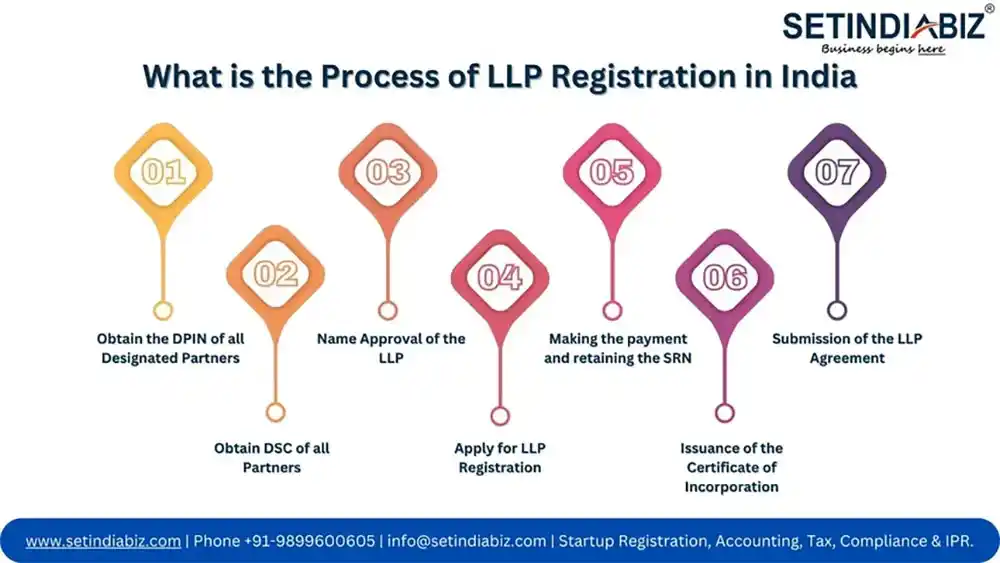
Step-by-step registration process of an LLP
How to register an LLP step by step: DSC, RUN-LLP name approval, FiLLiP with DPIN, PAN and TAN, then the LLP agreement with Form 3.
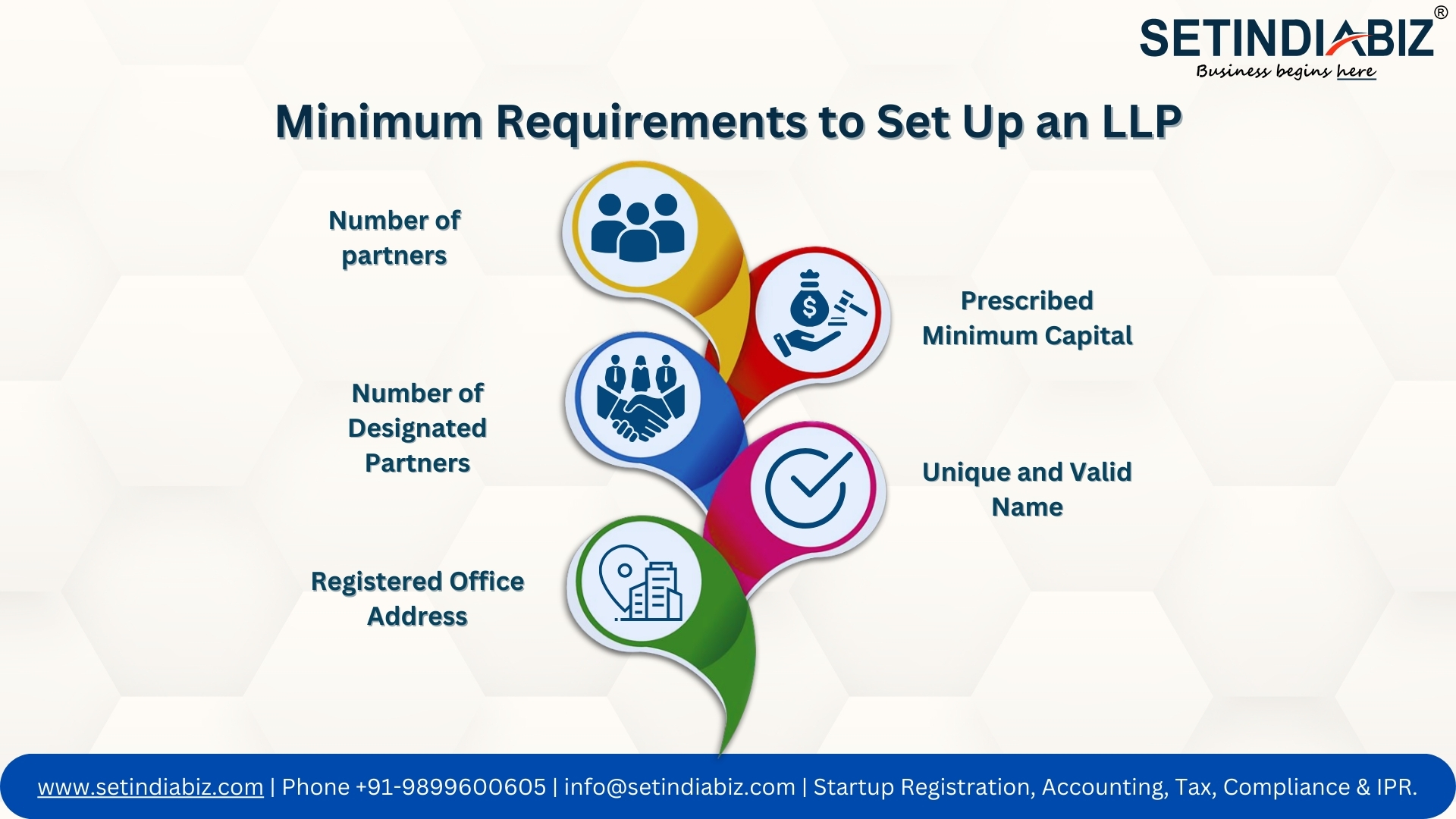
LLP registration documents in India
Which documents an LLP needs at registration: partner KYC, registered office proof and the owner’s NOC, with draft formats to use.

Advantages and disadvantages of an LLP
Where an LLP beats a firm or a company and where it falls short: limited liability and light filings, but no shares to issue.

Small LLP: meaning, definition and legal basis
Small LLP under Section 2(1)(ta): contribution up to ₹25 lakh and turnover up to ₹40 lakh, with lower late fees and halved penalties.
Frequently Asked Questions
Most answers cite the section or rule so that you can check it on mca.gov.in or India Code.
Basics & Structure
An LLP is a body corporate formed under the Limited Liability Partnership Act, 2008. It is a legal entity separate from its partners and has perpetual succession, so a change in partners does not end it (Section 3). The LLP agreement sets the partners’ rights and duties.
A firm under the Indian Partnership Act, 1932 is not a separate legal person, and its partners are jointly and severally liable for its debts. Registering a firm is optional under the central Act, but some States, such as Maharashtra, make it compulsory. An LLP must be registered, own property in its own name, and a partner is not personally liable for its obligations merely by being a partner (Section 28, LLP Act, 2008).
Both are separate legal entities with limited liability. A company has a board, holds board meetings and an AGM, and has its accounts audited every year. An LLP runs under its agreement, has no prescribed meetings, and needs an audit only above ₹40 lakh turnover or ₹25 lakh contribution (see Yearly Compliance for an LLP). An LLP cannot issue shares, so equity investors usually prefer a private limited company.
An LLP is small if its partners’ contribution is ₹25 lakh or less and its turnover in the previous financial year is ₹40 lakh or less; both conditions must be met (Section 2(1)(ta), LLP Act, 2008). A small LLP pays lower additional fees for late filing and half the penalties. See the small LLP entry for the details.
Yes. Once registered, an LLP can sue and be sued, and acquire, own, hold and dispose of property, all in its own name (Section 14, LLP Act, 2008). Its bank account, GST registration and licences are in the LLP’s name, not the partners’.
Partners & Eligibility
At least two, with no maximum (Section 6, LLP Act, 2008). If the LLP carries on business for more than six months with one partner, that partner, if aware of it, is personally liable for obligations incurred after those six months.
Any individual or body corporate, such as an Indian company or another LLP (Section 5, LLP Act, 2008). A person of unsound mind, an undischarged insolvent, or someone with a pending insolvency application cannot be a partner. A body corporate acts through an individual it nominates.
Designated partners are responsible for the LLP’s compliance, including filings and penalties for missing them (Section 8, LLP Act, 2008). Every LLP needs at least two partners, both individuals, and one must be resident in India, which means staying in India for 120 days or more in the financial year. Each needs a DPIN and a digital signature.
Yes, as the LLP agreement provides. The LLP files Form 4 within 30 days of a partner joining or leaving, or of a change in a partner’s name or address (Section 25, LLP Act, 2008). If the agreement changes, you file a fresh Form 3.
Process, Documents & Fees
Two MCA filings create the LLP: RUN-LLP to reserve the name and FiLLiP to incorporate the LLP; Form 3 for the LLP agreement follows. FiLLiP carries the incorporation document, the partners’ details and contribution, the office proof, and the designated partners’ consent; allots DPINs to up to five people; and applies for the PAN and TAN. A practising advocate, CS, CA or cost accountant certifies it (Section 11, LLP Act, 2008).
FiLLiP (Form for Incorporation of Limited Liability Partnership) is the MCA web form used to incorporate an LLP (Rule 11, LLP Rules, 2009). It can also reserve the name if RUN-LLP was not filed, allots DPINs to designated partners who do not have one, and applies for the LLP’s PAN and TAN, all in one application.
The Designated Partner Identification Number that every designated partner must hold (Section 7(6), LLP Act, 2008). A person who already has a DIN as a company director uses it as the DPIN. New designated partners get one through FiLLiP, with no separate application at incorporation.
Usually 10–15 working days once documents are complete: 1–2 working days for the digital signatures, 2–4 working days for RUN-LLP name approval, and the rest for FiLLiP and the Registrar. These are our figures; the Act sets 14 days as the Registrar’s outer limit for a complete filing (Section 12, LLP Act, 2008). A resubmission adds a round, and the LLP agreement then goes in with Form 3.
RUN-LLP costs ₹200. The FiLLiP and Form 3 fees follow the partners’ contribution: ₹500 and ₹50 up to ₹1 lakh, rising to ₹25,000 and ₹600 above ₹1 crore (Annexure ‘A’, LLP Rules, 2009). At the lowest slab, MCA fees total ₹750; the full table is under Government Fees for LLP Registration. Stamp duty is at actuals. Our professional fee starts at ₹2,499 for RUN-LLP, FiLLiP and the LLP agreement with Form 3; DSCs are charged separately and GST at 18% is extra.
LLP Agreement
It is the written agreement among the partners, or between the LLP and its partners, on contribution, profit sharing, management, and admission and exit. Where it is silent on a point, the default rules in the First Schedule of the Act apply (Section 23, LLP Act, 2008).
The first agreement is filed in Form 3 within 30 days of incorporation, and every change must be filed within 30 days of the change (Rule 21, LLP Rules, 2009). A late Form 3 can still be filed with an additional fee that rises with the delay, from the normal fee for up to 15 days; the full scale is in Yearly Compliance for an LLP.
Yes. It is signed on stamp paper or e-stamped at the value set by the stamp law of the State where it is signed, which in many States depends on the contribution, and then uploaded with Form 3. Your written estimate gives the exact duty; ten States are compared under Stamp Duty on the LLP Agreement by State.
Compliance & Tax
Form 11, the annual return, by 30 May, and Form 8, the statement of account and solvency, by 30 October (Sections 34 and 35, LLP Act, 2008). The LLP also files its income-tax return, and each designated partner files DIR-3 KYC once every third financial year. Late MCA forms pay an additional fee that rises with the delay. Our LLP annual compliance service handles them.
Above ₹40 lakh turnover or ₹25 lakh contribution, as MCA applies Rule 24(8) of the LLP Rules, 2009; Yearly Compliance for an LLP explains this. Partners may choose an audit anyway, and the auditor is a practising chartered accountant. A tax audit under the Income-tax Act, 2025 is a separate test.
From 1 April 2026, the Income-tax Act, 2025 treats an LLP as a firm. It pays 30% on its total income, plus a 12% surcharge where income exceeds ₹1 crore and 4% cess. A partner’s share of the profit is exempt in the partner’s hands where it follows the profit-sharing ratio in the LLP agreement (Schedule III, Sl. No. 2). Interest and remuneration to working partners are deductible within set limits, alternate minimum tax at 18.5% applies only if specified deductions are claimed, and no presumptive scheme is open to an LLP.
Yes. A partnership firm, a private company or an unlisted public company can convert into an LLP. Firm: LLP Form 17; private or unlisted public company: LLP Form 18; each filed together with FiLLiP (Sections 55 to 57, LLP Act, 2008 and Rules 38 to 40, LLP Rules, 2009). The conversion pays the same registration fee slabs as a new LLP.
Only when the law requires it: once turnover crosses ₹20 lakh for services (₹10 lakh in Manipur, Mizoram, Nagaland and Tripura) or ₹40 lakh for a supplier of goods only, with exceptions, or from the first inter-State supply of goods or sale through an e-commerce operator (Sections 22 to 24, CGST Act, 2017). GST is not part of incorporation, and an LLP can register earlier to claim input tax credit. See GST registration.
File the LLP agreement with Form 3 if it is not yet on record. Apply for a current account in the LLP’s name with the certificate, PAN, and agreement; the bank will open it under its own KYC rules. Bring in each partner’s contribution as agreed, and show the LLP’s name, registered office, LLPIN and limited-liability status on its invoices and letters (Section 21, LLP Act, 2008). Then register for GST, where applicable, and under the State Shops and Establishments Act, where it covers the office. Once the LLP has its PAN, it can register for free on the Udyam portal.
No. The LLP Act, 2008 sets no minimum contribution. Partners agree on their contribution in the LLP agreement, as money, property or services, and the total determines the FiLLiP and Form 3 fees. At ₹1 lakh or less, the MCA fees total ₹750.
Not fully. Partners can collect the papers and sign the forms. Still, FiLLiP must carry a statement by an advocate, company secretary, chartered accountant or cost accountant engaged in forming the LLP, and by a subscriber, that the law’s requirements are met (Section 11(1)(b), LLP Act, 2008).
No questions in this category yet. Choose another category or select “All”.
Request a Call / Quote
Tell us your State, your partners and the contribution you plan. We will send a written estimate showing professional fees, DSC charges, government fees, stamp duty, and GST separately, along with the scope, documents, timeline, and exclusions.
Written estimate first
Fee, statutory charges and GST shown separately, upfront.
Free consultation
A process expert explains the scope and options. No obligation.
Quality you can check
Defined deliverables; qualified professionals where required.
Support through completion
One point of contact, status updates and a support portal.
Clear scope and timeline
Documents needed, working-day timeline, exclusions listed.
Online, across India
Online delivery from Noida, Mumbai, Bengaluru, Hyderabad.
📞 +91 98996 00605 📧 info@setindiabiz.com
🕒 Mon–Sat · 9:30 AM – 6:30 PM IST How we handle your details: read our privacy policy.
