

Annual Return of Company AOC-4 & MGT-7 Filing
Every company files its audited accounts in Form AOC-4 and its annual return in Form MGT-7 or MGT-7A after the AGM. We prepare and e-file both for FY 2025-26 and Form ADT-1 in the years an auditor is appointed or reappointed.


Trusted By Leading Brands






























Company Annual Return Filing
Company annual return filing is the yearly disclosure every company makes to the Registrar of Companies: audited financial statements in Form AOC-4 under Section 137, Companies Act, 2013, and the annual return in Form MGT-7 or MGT-7A under Section 92. Both follow the AGM and apply to every company, whatever its turnover or activity.
Setindiabiz runs the cycle on the MCA V3 portal: audit coordination, AGM papers, then AOC-4 and MGT-7/7A, with ADT-1 in an auditor-appointment year. For FY 2025-26, every clock runs from your AGM, due by 30 September 2026.
AOC-4 & MGT-7 Form
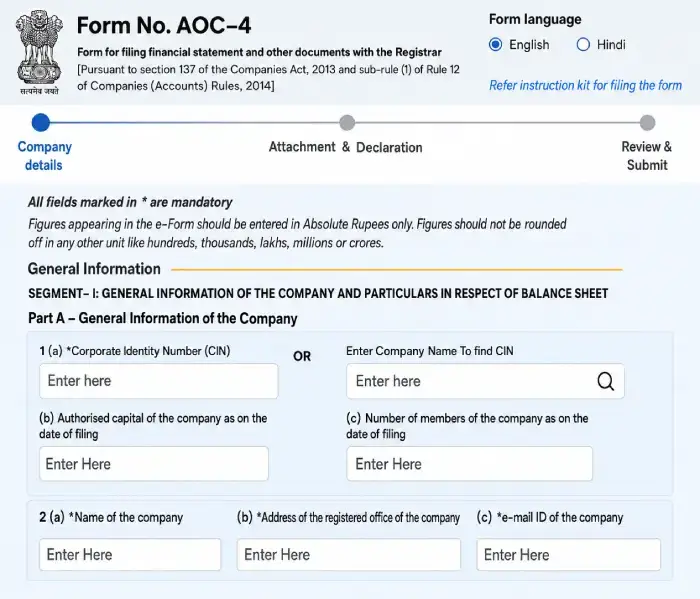
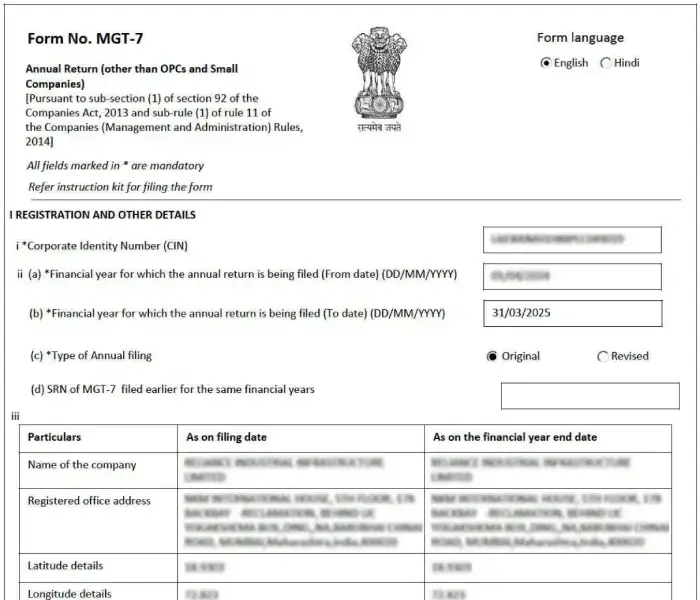
Setindiabiz is a private professional services firm unaffiliated with any government body and does not issue government documents. We assist in preparing and e-filing AOC-4, MGT-7/MGT-7A, and ADT-1 with the Ministry of Corporate Affairs (MCA). The filing acknowledgement (SRN) and compliance records are issued solely by the MCA.
Understanding AGM Requirements Under the Companies Act 2013
The Annual General Meeting is the anchor event of the compliance year. Under Section 96 of the Companies Act, 2013, shareholders meet once a year to adopt the audited financial statements, declare dividends, and transact the year’s other business. A subsequent AGM falls within six months of the year-end, and no more than fifteen months may separate two meetings. Because the AOC-4 and MGT-7 clocks both start from the AGM, fixing the meeting date early settles the entire filing calendar.
Due Date of AGM and Annual Filing for FY 2025-26
| Incorporation Date | AGM for FY 2025-26 | AOC-4 | MGT-7/7A | ADT-1, if applicable |
|---|---|---|---|---|
| On or before 31-12-2024 | Hold AGM By 30-09-2026 (Subsequent AGM) | By 30-10-2026 | By 29-11-2026 | By 15-10-2026 |
| 01-01-2025 to 31-12-2025 | First AGM by 31-12-2026 (nine months from 31-03-2026) | Within 30 days of the AGM | Within 60 days of the AGM | Within 15 days of the AGM |
| 01-01-2026 to 31-03-2026 | NO AGM in FY 2026 at all First financial year ends 31-03-2027; first AGM by 31-12-2027 | No Filing for FY 2025-26 | No Filing for FY 2025-26 | Not applicable |
Note: Your FY 2025-26 deadlines depend on when the company was incorporated, because Section 2(41) fixes the close of the first financial year and Section 96 then sets the AGM window. The table gives the last permitted dates; an earlier AGM moves every later filing forward by the same margin. The notice must go out 21 clear days before the meeting under Section 101, so a 30 September AGM needs its notice issued in the first week of September.
Holding the AGM by Video Conferencing or Elsewhere in India
🧭 AGM Through Video Conferencing
A 2026 AGM can be held entirely over video conferencing or other audio-visual means. MCA General Circular No. 03/2025 dated 22 September 2025 permits AGMs and EGMs through VC/OAVM till further orders, continuing the framework of General Circular No. 20/2020 dated 5 May 2020: recorded proceedings, quorum counted through attendance on the call, and voting as that framework prescribes.
🧭 Physical AGM
A physical AGM ordinarily follows Section 96(2): between 9 a.m. and 6 p.m., on any day that is not a National Holiday, at the registered office or another venue within the same city, town or village. Sundays are permitted. The first provision, inserted by the Companies (Amendment) Act, 2017 with effect from 13 June 2018, lets an unlisted company meet anywhere in India if every member consents in advance.
Consequences of Default in Holding the AGM: Missing the AGM is a punishable default on its own. Under Section 99, Companies Act, 2013, the company and every defaulting officer face a fine of up to ₹1,00,000, plus ₹5,000 for each day the default continues. Two lawful exits exist: the company may request an ROC extension of up to three months on e-form GNL-1 for special reasons before the due date under Section 96(1), though a first AGM cannot be extended. If the AGM is not held, Section 137(2) still requires filing financial statements, with reasons, within 30 days of the last date the meeting was due.
One Person Company (OPC) Annual Return
An OPC has one member, so Parliament removed the meeting and fixed the calendar instead. Section 96(1) excludes an OPC from holding an AGM, and Section 122 disapplies the general-meeting machinery, yet both annual filings remain fully mandatory. The dates below are fixed by statute for a financial year ended 31 March 2026, which makes OPC compliance easier to plan than that of any other company, and easier to miss for the same reason: no meeting reminds you.
| Compliance | Incorporated in 2026 (on or after 1st Jan 2026) | Incorporated Before 2026 (On or before 31 Dec 2025) | Basis |
|---|---|---|---|
| AGM | Not Applicable | Not Applicable | Not Applicable |
| Form ADT-1 | Not Applicable | Not Applicable | 15th Day of Appointment |
| Form AOC-4 | Not Applicable | 27-09-2026 | 180 days from FY close, under the proviso to Section 137(1) |
| Form MGT-7A | Not Applicable | 29-11-2026 | 60 days from 30-09-2026, the date an AGM would otherwise fall due, under Section 92(1) read with Section 96(1) |
An OPC also files lighter paperwork: its financial statements may omit the cash flow statement under the proviso to Section 2(40), and its Board’s Report follows the abridged Rule 8A of the Companies (Accounts) Rules, 2014. Auditor rotation under Section 139(2) does not apply. The statutory audit itself remains compulsory, even for a NIL-transaction year, and an ADT-1 still follows any appointment or reappointment of the auditor.
Essential Documents for AGM and Annual Return Filing
Annual filing is document-led: the forms are short, but each attachment is prescribed, and the ROC system rejects an incomplete pack. Everything begins once the statutory audit is signed, because the AGM adopts audited statements and both AOC-4 and MGT-7 draw on them. You can hand the drafting to us after the audit; the checklist below is grouped by the stage each paper serves, from the meeting itself through to the e-forms filed after it.
Drafted for the AGM
-
Notice of AGM ?Issued 21 clear days before the meeting under Section 101, with the agenda, draft resolutions and the Section 102 explanatory statement for any special business.
-
Directors’ Report ?the board’s yearly account under Section 134 read with Rule 8 of the Companies (Accounts) Rules, 2014; small companies and OPCs use the abridged Rule 8A format.
-
Audited financial statements ?Balance sheet, profit and loss account, notes, and the cash flow statement unless the proviso to Section 2(40) exempts the company.
-
Auditor’s Report ?The statutory auditor’s opinion under Section 143 on the balance sheet and profit and loss, circulated with the notice and adopted at the AGM.
Attached to AOC-4
-
Audited financial statements ?Balance sheet, profit and loss account, notes, and the cash flow statement unless the proviso to Section 2(40) exempts the company.
-
Form AOC-1 ?The statement of subsidiaries, associates and joint ventures under Rule 5, filed only where the company has them.
-
Form AOC-2 ?Particulars of related-party contracts under Section 188, annexed to the Directors’ Report where such contracts exist.
For MGT-7/7A
-
Shareholding and member data ?The register of members, shareholding pattern, and the year’s transfers, director and KMP changes, as on 31 March 2026.
-
Details of Changes in Company ?All changes in the company such as Registered Address, Director, Shareholder, etc must be compiled before MGT-7 Filing.
For ADT-1
-
Auditor’s consent and eligibility certificate ?The written consent and Section 141 eligibility certificate under Rule 4(1), collected before the appointment is voted.
-
Appointment resolution ?The AGM resolution, or the board resolution for a first auditor, that ADT-1 reports to the ROC.
Important Note for Small Companies
Private limited companies classified as small companies (paid-up capital ≤₹4 crores AND turnover ≤₹40 crores) are exempt from preparing Cash Flow Statements as part of their financial statements. Such companies only need to prepare a Balance Sheet, Profit & Loss Account, and Notes to Accounts, significantly reducing the compliance burden.
AOC-4 (Filing Of The Financial Statement)
Form AOC-4 places the company’s audited accounts on the public record. Section 137, Companies Act, 2013 requires every company to file its adopted financial statements, auditor’s report, and Directors’ Report within 30 days of the AGM’s conclusion, so 30 October 2026 is the last date, as the AGM is held on 30 September 2026. The e-form carries the digital signature of a director, CEO, CFO or manager, and a practising CA, CS or CMA certifies its correctness before submission on MCA V3.
List of Documents for AOC-4 Filing
| No | Document Category | Required Documents |
|---|---|---|
| 1 | Financial Statements |
|
| 2 | Audit Documentation |
|
| 3 | Board Documentation | Board’s Report, CSR Report (if applicable), Details of other entities, etc. (Note: MGT-9 extract is no longer an attachment; a web link to the annual return is placed in the Board’s Report). |
| 4 | Compliance Certificates |
|
Delay or Default in Filing of AOC-4
Late AOC-4 filings incur an uncapped additional fee of ₹100/day on the MCA portal. Under Section 137(3), defaults attract a separate penalty of ₹10,000 plus ₹100/day, capped at ₹2,00,000 for the company and ₹50,000 for the responsible officer (MD, CFO, or board-designated person). If accounts remain unadopted, they must be filed within 30 days of the AGM, and adopted accounts within 30 days of the adjourned AGM. Under Section 137(2), if no AGM occurs, filings detailing the reasons must be submitted within 30 days of the last permitted meeting date. Through CCFS-2026, eligible defaulting companies can clear past AOC-4 filings at 10% of the accumulated additional fees until 31 August 2026.
Annual Return Of Company (Form MGT-7/7A)
The annual return is the company’s yearly identity statement under Section 92, Companies Act, 2013: registered office, principal business, shareholding pattern, members, transfers, directors and KMP, meetings, remuneration and penalties, all as on 31 March 2026. It is filed within 60 days of the AGM, making 29 November 2026 the last date for an AGM held on 30 September 2026. Filing applies to every company; size changes only the form and the signatures.
🧭 MGT 7A
MGT-7A is the abridged return for an OPC and a small company; small-company means a company with paid-up capital up to ₹4 crore and turnover up to ₹40 crore, tested together.
🧭 MGT-7
Holding, subsidiary, Section 8, and special Act companies must file the full MGT-7. Form MGT-7 requires signatures from both a director and a company secretary.
🧭 MGT-8
A practising company secretary must certify the annual return in Form MGT-8 for any listed company, or any company having a paid-up capital of ₹10 crore or more, or a turnover of ₹50 crore or more.
Due Date & ROC Fee: The normal filing fee runs from ₹200 for authorised capital below ₹1,00,000 to ₹600 for ₹1 crore and above, under the slab table later on this page. Miss the 60-day window and the return can still be filed, but with an additional fee of ₹100 for each day of delay and exposure to the Section 92(5) penalty of ₹10,000 plus ₹100 per day, capped at ₹2,00,000 for the company and ₹50,000 per officer.
Form ADT-1 (Intimation Of Auditor Appointment)
ADT-1 is event-driven, not annual. Under Section 139(1), Companies Act, 2013, an auditor holds office from the conclusion of the appointing AGM until the conclusion of the sixth AGM, a five-year term, and the requirement of ratification at every AGM was omitted by the Companies (Amendment) Act, 2017 with effect from 7 May 2018. So the company files ADT-1 in the year it appoints or reappoints an auditor, and files nothing under this head in the intervening years.
When the filing is triggered, the deadline is 15 days from the appointing meeting, so 15 October 2026 for an appointment made at a 30 September 2026 AGM. Rule 4 of the Companies (Audit and Auditors) Rules, 2014 places the duty on the company, not the auditor, and the auditor’s written consent with a Section 141 eligibility certificate under Rule 4(1) rides as an attachment.
ROC Fee For Filing Of AOC-4, MGT-7 And ADT-1
The government fee for each form is fixed by the Companies (Registration Offices and Fees) Rules, 2014 and depends only on the company’s authorised capital, not on turnover or profit. The same slab applies to AOC-4, MGT-7/7A and ADT-1 alike, so a company budgets one number per form. What differs sharply is the cost of delay: the two annual forms accrue a flat daily additional fee with no ceiling, while ADT-1 follows the older multiple-of-normal-fee slabs.
| No. | Authorised Capital | Normal ROC Fee (Rs) |
|---|---|---|
| 1 | Less than 1,00,000 | 200/- |
| 2. | 1,00,000 to 4,99,999 | 300/- |
| 3. | 5,00,000 to 24,99,999 | 400/- |
| 4. | 25,00,000 to 99,99,999 | 500/- |
| 5. | 1,00,00,000 or more | 600/- |
Late AOC-4 and MGT-7/7A carry an additional fee of ₹100 per day of delay, per form, without any maximum, in force since 1 July 2018 under G.S.R. 435(E) dated 7 May 2018. A late ADT-1 instead pays a multiple of the normal fee: 2× up to 30 days, 4× up to 60 days, 6× up to 90 days, 10× up to 180 days, and 12× beyond that. A company that filed nothing for two years can owe more in additional fees than its capital, and CCFS-2026 cuts exactly that burden to 10% until 31 August 2026.
The Process for Company Annual Return Filing
Annual filing is a relay, and the baton is the audited financial statement. We run the sequence in the order the law works: accounts and audit first, AGM papers next, the meeting itself, then the e-forms. Step four runs only in a year when an auditor is appointed or reappointed. The cards below show what we do, what you do, and the statutory clock on each leg, so you can see the whole FY 2025-26 season before it begins.
Step 01 - Close the books and complete the statutory audit
First, we help you finalise the FY 2025-26 accounts and coordinate the statutory audit under Section 139 to Section 143. Your auditor reports on the balance sheet and profit and loss; those audited statements anchor the AGM and every filing that follows.
⏳Turnaround: Complete before the AGM notice is issued.Step 02: Draft the Board's Report and AGM notice
Next, we draft the Directors’ Report under Section 134 and Rule 8, or the abridged Rule 8A version for small companies and OPCs, plus the AGM notice with agenda and draft resolutions, issued 21 clear days ahead under Section 101.
⏳Turnaround: Notice issued 21 clear days before the AGM.Step 03: Hold the AGM and record the minutes
You hold the AGM by 30 September 2026, physically under Section 96(2) or over VC/OAVM under GC 03/2025, to adopt the accounts and transact the year’s business. We prepare the resolutions and the minutes, entered within 30 days under Section 118.
⏳Turnaround: Meeting day; minutes entered within 30 days.Step 04: File ADT-1 when an auditor is appointed
This step runs only in an appointment year. Where the AGM appoints or reappoints an auditor, we collect the consent and eligibility certificate under Rule 4(1) and file ADT-1 within 15 days under Section 139(1). A running five-year term needs no filing.
⏳Turnaround: Within 15 days of the appointment; skipped otherwise.Step 05: File AOC-4 with the audited statements
Then we prepare AOC-4, or AOC-4 XBRL/CFS where applicable, attach the audited statements, reports and AOC-1, obtain the director’s DSC and certification by a practising CA, CS or CMA, and file under Section 137 within 30 days of the AGM.
⏳Turnaround: Filed within 30 days of the AGM.Step 06: File MGT-7 or MGT-7A and close the year
Finally, we compile the annual return, shareholding, transfers and director changes included, and file MGT-7 or MGT-7A under Section 92 within 60 days of the AGM, with MGT-8 certification where Rule 11(2) thresholds apply. You receive all SRNs.
⏳Turnaround: Filed within 60 days of the AGM.Understanding Legal Provisions and Consequences
The annual filing framework is governed by comprehensive legal provisions under the Companies Act, 2013, designed to ensure corporate transparency and accountability. Key legislations include Section 92 (Annual Return), Section 137 (Filing of Financial Statements), and Section 134 (Board’s Report). These are supported by the Companies (Management and Administration) Rules, 2014, and the Companies (Accounts) Rules, 2014. Non-compliance attracts significant penalties for both the company and its officers, making timely filing crucial.
Penalty Structure under the Companies Act, 2013
| Entity/Person | Type of Violation | Penalty Amount (under Adjudication) |
|---|---|---|
| Company | Default in filing Annual Return (MGT-7) under Section 92(5) | ₹10,000 + ₹100/day of default (Max: ₹2,00,000) |
| Company | Default in filing Financials (AOC-4) under Section 137(3) | ₹10,000 + ₹100/day of default (Max: ₹2,00,000) |
| Directors / Officers | Default in filing Annual Return / Financials under Section 92(5) & 137(3) | ₹10,000 + ₹100/day of default (Max: ₹50,000 per person) |
| Directors / Officers | Non-compliance in holding AGM under Section 99 | Fine up to ₹1,00,000 & for continuing default, a further fine up to ₹5,000/day |
| Directors | Continuous default for 3+ years in filing financials/annual returns under Section 164(2)(a) | Disqualification for a period of 5 years |
| Any Person | Knowingly filing false or incorrect information under Section 447, read with 448 | Imprisonment (6 months to 10 years) AND Fine (not less than the fraud amount, up to 3 times the amount) |
| Certifying CS | Incorrect certification of Annual Return (MGT-7) under Section 92(6) | A penalty of ₹2,00,000 |
Note: The penalties above are statutory penalties imposed through adjudication and are distinct from the automatic additional (late) fees levied by the MCA portal for delayed filings.
Recent Legal Updates
The Ministry of Corporate Affairs regularly updates the compliance framework. Significant changes were introduced through the Companies (Amendment) Acts of 2019 and 2020, which re-categorised many offences from criminal (prosecution) to civil wrongs (adjudication by ROC) and established the current penalty structure. Companies must stay updated with the latest circulars, including any relaxations for specific entities like IFSC companies, to ensure full compliance and avoid these stringent consequences.
Frequently Asked Questions
It is the yearly ROC disclosure every company makes after its AGM: audited financial statements in Form AOC-4 under Section 137 and the annual return in Form MGT-7 or MGT-7A under Section 92 of the Companies Act, 2013. Together they place the company’s finances, shareholding and management on the public record for FY 2025-26.
Yes, both remain mandatory in a NIL year. Sections 92 and 137 apply to every company on the register, so a zero-transaction company still gets its accounts audited and files AOC-4 and MGT-7/7A, and files ITR-6 for FY 2025-26. Dormant status under Section 455 is not an exemption either: it brings its own filings, including the annual Form MSC-3.
MGT-7A is the abridged annual return for an OPC and a small company under the proviso to Section 92(1), introduced with effect from 5 March 2021. It seeks fewer disclosures and can be signed by a director where there is no company secretary. All other companies file the full MGT-7, and larger ones add MGT-8 certification.
Under Section 2(85) read with Rule 2(1)(t), as amended by G.S.R. 700(E) dated 15 September 2022, paid-up capital must be up to ₹4 crore and turnover up to ₹40 crore, both together. Size alone does not decide it: holding companies, subsidiaries, Section 8 companies and bodies governed by a special Act are excluded, however small they are.
No, they run on separate laws and portals. AOC-4 and MGT-7 go to the MCA under the Companies Act, 2013, while ITR-6 goes to the Income Tax Department; for FY 2025-26 the return remains governed by the Income-tax Act, 1961 and falls due by 31 October 2026 for audit cases, 30 November 2026 where transfer pricing applies. A company completes both.
Three different mechanisms. AOC-4 is DSC-signed by a director, CEO, CFO or manager and certified as correct by a practising CA, CS or CMA. MGT-7 carries a director’s and the company secretary’s signature under Section 92(1), or a practising CS where there is no CS. MGT-8 certification by a PCS applies only where Rule 11(2) is triggered.
For a company holding its AGM on 30 September 2026: AOC-4 by 30 October 2026 and MGT-7/7A by 29 November 2026, under Sections 137 and 92. If that AGM also appoints or reappoints the auditor, ADT-1 follows by 15 October 2026. The clocks run from your actual AGM date, so an earlier meeting means earlier deadlines throughout.
Within nine months of the close of its first financial year, under Section 96(1). A company incorporated between 1 January 2025 and 31 December 2025 has its first financial year ending 31 March 2026 and must hold the first AGM by 31 December 2026; one incorporated on or after 1 January 2026 closes its first year on 31 March 2027. The ROC cannot extend a first AGM.
Yes, fully virtual AGMs remain permitted. MCA General Circular No. 03/2025 dated 22 September 2025 allows AGMs and EGMs through VC/OAVM till further orders, on the recorded-proceedings and quorum framework of General Circular No. 20/2020. The Section 96 due date is unchanged, so the virtual meeting must still conclude by 30 September 2026.
Under Section 96(2), between 9 a.m. and 6 p.m. on any day that is not a National Holiday, at the registered office or elsewhere in the same city, town or village. Sundays are allowed. An unlisted company may meet anywhere in India under the first proviso if all members consent in advance, in writing or electronically. Notice still runs 21 clear days under Section 101.
Yes, for any AGM other than the first. On an application in e-form GNL-1 filed before the due date, the ROC may grant up to three months’ extension for special reasons under the third proviso to Section 96(1), such as a delayed audit or loss of key personnel. The extension is discretionary, and the AOC-4 and MGT-7 clocks then run from the AGM actually held.
The default is punishable by itself: Section 99 imposes a fine of up to ₹1,00,000 plus ₹5,000 per day it continues, and the Tribunal can call the meeting under Section 97. The filings do not pause either. Section 137(2) requires the financial statements to be filed with reasons within 30 days of the last date the AGM should have been held.
The core pack: audited balance sheet and profit and loss with notes, the auditor’s report, the Directors’ Report, the AGM notice and resolutions, and the shareholding pattern and member data as on 31 March 2026, plus AOC-1 for subsidiaries and AOC-2 for related-party contracts where they exist. An appointment year adds the auditor’s consent and eligibility certificate for ADT-1.
No. An auditor is appointed for five consecutive years under Section 139(1), and the requirement to ratify the appointment at every AGM was omitted with effect from 7 May 2018. ADT-1 is filed within 15 days of an appointment or reappointment, including a first auditor under Section 139(6) and a casual vacancy under Section 139(8), not in the intervening years.
File twice under Section 137(1). The unadopted statements go to the ROC within 30 days of the original AGM, and the adopted statements follow within 30 days of the adjourned meeting at which they clear. The MGT-7 clock runs from the conclusion of the AGM, so record both dates carefully in the minutes.
Only if the company has one. Section 92(3) requires a company with a website to place a copy of the annual return on it and disclose the web-link in the Directors’ Report. A company without a website has no obligation to create one, and the Board’s Report simply omits the link. We add the link text while drafting the report so nothing is missed.
MGT-7 is signed by a director and the company secretary; where the company has no CS, a company secretary in practice signs, under Section 92(1). The CS signs MGT-7A for an OPC or small company or, where there is none, by a director alone. Where Rule 11(2) thresholds apply, a PCS additionally certifies the return in Form MGT-8.
Under Section 128(6), Companies Act, 2013, the managing director, the whole-time director in charge of finance, the CFO or the person charged by the board with compliance faces a fine of ₹50,000 to ₹5,00,000.
The normal fee per form is based on authorised capital under the Companies (Registration Offices and Fees) Rules, 2014: ₹200 below ₹1,00,000, ₹300 up to ₹5,00,000, ₹400 up to ₹25,00,000, ₹500 up to ₹1 crore, and ₹600 at ₹1 crore or more. The same slab applies to all three forms; certification and professional charges are separate.
The additional fee is the automatic portal levy: ₹100 per day per late AOC-4 or MGT-7/7A, uncapped, paid at upload under Section 403. The penalty is a separate adjudicated amount under Section 92(5) or 137(3): ₹10,000 plus ₹100 per day, up to ₹2,00,000 for the company and ₹50,000 per officer. Paying the fee never wipes the penalty.
The Companies Compliance Facilitation Scheme, 2026, notified by MCA General Circular No. 01/2026 dated 24 February 2026, lets eligible companies clear pending MGT-7/7A, AOC-4 variants, ADT-1, FC-3 and FC-4 at the normal fee plus only 10% of additional fees. General Circular No. 03/2026 extended it from 15 July to 31 August 2026 after the MCA data-centre fire of 5 June 2026.
Companies already served a final strike-off notice under Section 248(1), those that have themselves applied for strike-off or dormant status, companies dissolved by amalgamation, and vanishing companies are outside the scheme. For Sections 92 and 137, filing before an adjudication notice or within 30 days of one concludes the proceedings without penalty. A Section 96 default gets no immunity.
Yes, up to 31 December 2026 for AY 2026-27 under Section 139(4) of the Income-tax Act, 1961, with a Section 234F fee of up to ₹5,000, restricted to ₹1,000 where total income does not exceed ₹5 lakh. A belated return costs more than the fee: FY 2025-26 business losses cannot be carried forward, and interest under Sections 234A to 234C keeps running.
Check eligibility, then regularise under CCFS-2026 while the window lasts. We reconstruct the accounts, complete the pending audits, hold or record the overdue meetings, and file every pending AOC-4 and MGT-7/7A at 10% of the accumulated additional fees. After 31 August 2026, the full ₹100 per day burden and adjudication exposure return.
